
The World's Best Failed Project
Will Moran got the interviews, the footage, the fancy rights agreements, and a great sizzle. What he never found was the one sentence that could sell it.

Guest Case File 005: Will Moran / Madame General
Will Moran spent 22 years at Google building studios, production teams, and hundreds of corporate videos. He worked at YouTube and understood cameras, crews, edits, schedules, executives, and the strange corporate art of making something complicated feel clean but he had never made the documentary he actually wanted to make.
Then, coming out of the pandemic, he decided he’d waiting long enough, took some time off from work and went looking for a story near where he grew up in Scranton, Pennsylvania.
That search led him to Kathleen Kane, the former Pennsylvania attorney general whose career had ended in scandal and conviction. Will remembered her vaguely as a dishonored politician. His sister, who had previously worked with Kane, told him there was more to the story and gave him Kane’s phone number.
Will called. Kane agreed to sit down. He found a local Scranton cameraman with two small cameras and a warehouse studio, and shot the first interview for about seven hundred dollars.
That was supposed to serve as the beginning of a documentary about Kathleen Kane.
Instead, it opened onto a much wider film about the Penn State scandal.
Kane told him that the real story behind what happened to her ran through the Penn State scandal. So Will followed that thread. He interviewed Graham Spanier, the former Penn State president got inside Joe Paterno’s house pursued life-rights agreements assembled footage, access, a teaser, and a package that, on paper, looked like exactly what independent documentary development was supposed to look like.
And that is where the project started to fall apart.
Not because Will had nothing.
Because he had too much.
Was the film about Kathleen Kane? Graham Spanier? Joe Paterno? Penn State? Jerry Sandusky? Prosecutors? Politics? Institutional panic? The destruction of reputations? A scandal that may still be more complicated than the public memory of it?
Every new piece of access made the project more impressive yet less clear.
By the time Will sent the sizzle around town, including eventually to my development exec Aditya, he had what looked like a serious package but what he did not have was the one thing every buyer needs before they risk their job on a documentary:
A clean sentence.
The film never got greenlit. But Will does not describe it as a waste. He calls it “the world’s best failed project,” because it gave him something maybe just as valuable as a greenlight…
This conversation has been edited and condensed for clarity.
Adam Bhala Lough: I’d love to hear from the beginning: when did you first get the seed of the idea to make the doc? And what was going on in your career at that time?
Will Moran: I had been at Google for quite a while. I just left after 22 years. I was doing production in all different manners: communications, marketing. I was at YouTube for a while. It was a very long successful career.
I built studios and production teams. I was kind of there since the beginning. I never really wanted to do engineering. I always wanted to be a filmmaker.
So I pivoted within the first year and basically ran Google’s first video-production team and built our first studio. Over the next 20 years, I continued to do that: run studios, do creative work, make hundreds of short corporate videos.
And then, on the side, I’d been writing screenplays the entire time. I always wanted to write and make a feature. That was really my creative passion.
At Google, we made a ton of short documentaries. Pretty much everything we did was some form of documentary. But the idea of taking on a full documentary project was daunting with my day job. It didn’t really seem tenable.
Then, through working with my friend John Crawford, I watched him go through the process of making The Invisible Pilot, which ultimately ended up on HBO. This was through the pandemic era, when documentaries were super-hot and everybody was buying them.
I saw a different model than what I had thought of. I always thought of documentary as: you pick up your camera, go follow subjects for years, edit it yourself or pay someone to edit it, and maybe eventually you have a film.
Then I saw that you could do research, find your subjects, get life-rights agreements, build out the story, shoot some initial interviews, cut together a teaser, and propose a documentary around a subject you cared about. Maybe a studio or a production company would come in and partner with you.
Of course, as you probably know, that model didn’t last very long.
Adam: So this was around the pandemic, when you first conceived of the idea?
Will: Yeah, coming out of it. Around 2021 or 2022.
I’m from Scranton, Pennsylvania. There’s always been a lot of interesting drama going on in Scranton politics. There’s organized crime and all kinds of different things. Growing up there, I always thought there was probably something local I could find that would be interesting.
I was talking to my sister, and she said she used to work with Kathleen Kane and that maybe I’d be interested in talking to her.
I vaguely remembered Kathleen Kane. My initial reaction was that I remembered her as some corrupt politician. My sister said, “Yeah, I think there was more to it than that.”
Then she said, “I have her number if you want to talk to her.”
So I wound up calling Kathleen Kane. That was really the beginning of what became a much bigger odyssey into the whole Penn State scandal. It started with Kathleen.
I went out to Scranton and interviewed her. At that point, Penn State was really the background of it all. At the end of the sizzle, she says, “This all happened because of Penn State.”
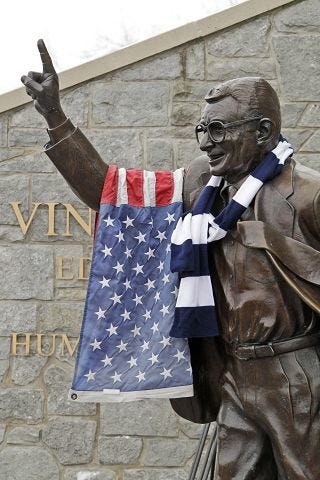
She had gotten elected on the idea that she was going to investigate the Penn State investigation: why it was so complicated and twisted, why it took so long. Then she immediately butted heads with Frank Fina, the prosecutor who had been involved in the Sandusky case, the Spanier case, and ultimately her own case.
There was this one through-line running through all of it. The Penn State scandal.
Adam: Let’s stop you there, because I think this is interesting for my readers. You’re calling a very high-level public figure, someone who had been convicted, reviled by the media, and had her entire career destroyed. Why would she talk to you?
And then, once she agreed, who paid for the shoot? What did the crew look like? Did you use people from Google? Did you hire locally?
Will: The personal connection through my sister is really what got me the interview.
Kathleen said, “Your sister’s one of the nicest people I’ve ever met. If she says I can trust you, then I trust you.”
My sister had worked in the DA’s office in Scranton at the same time Kathleen was there, before she went into more formal politics. My sister said Kathleen was one of the loveliest people she had ever worked with. That was really interesting to me because it wasn’t what I expected based on my vague memory of how the whole thing went down.
So she gave me her number we wound up on a phone call, and she agreed to give me an interview the next time I went out to Scranton.
I was self-funding the entire thing. It was just an idea: let me see if I can get something recorded that might be interesting for a documentary.
I knew how expensive production could be, especially in the Bay Area. A one-day shoot can cost many thousands of dollars. I wanted to spend very little money.
I found a local guy in Scranton. He had a little studio in a warehouse. I don’t remember what camera he had. Kathleen walked in with this head-to-toe white suit, the environment was very stark, and then I saw this kind of crazy chair she was sitting in. I just thought, “Okay, that’ll work.”
We threw one light on her. He had two small cameras. It was a very bare-bones setup. I think I spent around $700. His rate was really low.
We filmed in the warehouse on two small cameras. It was one day, maybe an hour and a half.
Adam: That’s fast. And a very short interview. Did you intend to go back when you got it set up and interview her more extensively?
Will: Yeah. I was hoping that, because it seemed like a really interesting story, I could use that sizzle to find a production partner who could help fund some of it. Then we could go back and do a much more polished, extensive interview.
But the interesting thing was that she concluded by saying the whole reason all this happened was Penn State.
I came back from that interview and started working with a friend who had high-level editorial skills. I have very basic editorial skills. He helped get the project conformed in Premiere, laid out in a timeline, with selects. Once the technical heavy lifting was done—the cameras synced, the audio conformed—I could spend hours moving things around and doing more of the creative work.
But the story was already getting really crazy and wild. I was going down rabbit holes with all these different characters and people. I think I was getting a little in over my head. It was just too big and too complicated.
Then, in the middle of it, Graham Spanier, the former president of Penn State, came out with a book called In the Lion’s Den, arguing that he had been wrongfully convicted.
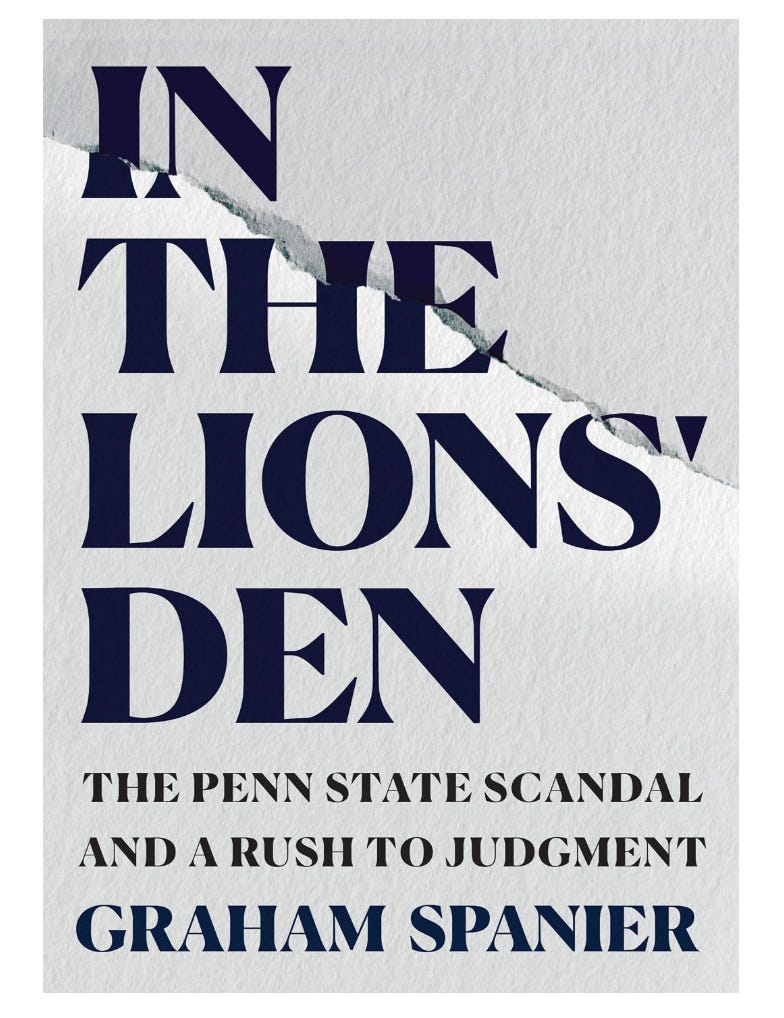
I thought, “I wonder if he’ll talk to me?” I was already surprised Kathleen Kane had talked to me.
I found an email address through what I think was a Facebook page for his book release. I emailed him and said, “I’m working on this. I’ve interviewed Kathleen Kane. I’m interested in the Penn State saga and everything that’s happened. Would you be willing to talk to me?”
And he said yes.
Adam: So now you’re pausing the Kathleen Kane side of the documentary to try to figure out what’s going on with Penn State.
Will: Right. She had said, “This is all about Penn State.” So I thought, let me figure out what’s going on with Penn State.
And, to my real shock and amazement, Graham was willing to talk to me.
So I flew back to Pennsylvania. I had interviewed Kathleen in November of 2021, and this was probably the spring of 2022. I was going to State College.
Again, I found a local guy. He was $1200 for two cameras, a microphone, and operating the whole day. I’m used to spending tens of thousands of dollars on a two-camera shoot, so I was like, “Okay, this sounds great.”
Graham agreed to let us film.
Then, along the way, he said, “Hey, would you want to interview Joe Paterno’s widow? I might be able to get you an interview.”
He literally called her on the phone right there.
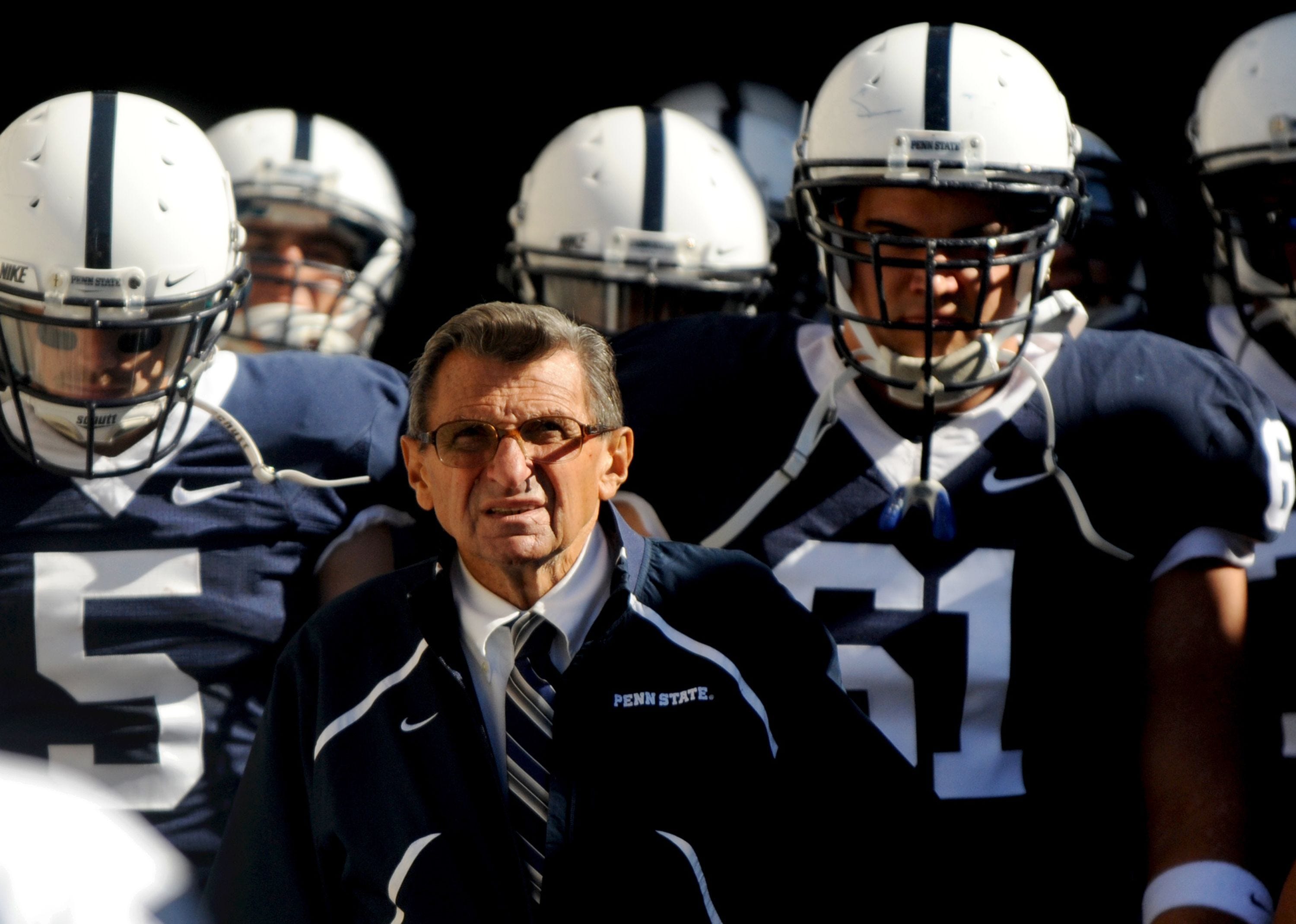
One thing led to another. They weren’t going to let me film, but I wound up going over to Joe Paterno’s house that day, where a lot of the drama had played out when Sandusky was being arrested.
It was very surreal.
Paterno’s widow was walking me through what happened. She started crying. She said the media had stepped all over her roses. It was 10 years later and she was reliving the whole thing.
And I was dying because I wasn’t recording any of it.
I had agreed not to record it. Everything she said, every move—it was kind of like a knife in my heart. I thought, “I really wish people could see and hear this.”
You probably know that feeling as a filmmaker.
Adam: Yeah, I do.
Will: Then I came back, and I should also say I took the time to get the life rights to Kathleen Kane’s story and Graham Spanier’s story.
I worked with a lawyer. We wrote up basically shopping agreements for both of them. That cost money, too.
That was probably the most expensive part of the whole thing. Even though I tried to keep it simple and streamlined, there was still back-and-forth. It wound up costing thousands of dollars for both of them.
With this model of wanting to shop the project to production companies or studios, I felt like having those agreements secured was really important.
If I were doing it again, I’m not sure I would prioritize that in the same way.
Just seeing how hard these things are to bring to fruition, and how much is built on trust and relationships, I think I would do it at some point. But I don’t think I would lead with that. I might have even done it before I filmed both of them.
Adam: Whoa.
Will: I really put it at the top.
Then I had a whole bunch of footage of Graham as well, and I think that’s where things started to fall apart.
I started pitching it. I had some connections through my friend. He got me connected to different people, and you were one of them. That’s why we connected on LinkedIn.
You agreed to let me send the sizzle to somebody at your production company. We never heard back, but that was very common.
I was just kind of randomly reaching out to anybody I knew and trying to get the sizzle in front of people.
I think I had an earlier version of the sizzle that had a lot more Graham Spanier and Penn State stuff in it. It had become very bloated and confusing as a story.
I landed on Madam General pretty early because I thought Kathleen was a great character. Even though I was starting to focus more on Penn State, I kept it focused on her.
Adam: I’m trying to see if it ever made it to me. (I search through my email).
Will: I think you told me to send it to Aditya.
Adam: Yeah, Aditya. That’s our development executive.
That’s interesting because with every project that comes to us, he’ll do coverage on it. But he didn’t even do coverage on this. So he must have thought it wasn’t at all right for our company.
But in retrospect, thinking about it, you did have a really good package. I would ask two questions:
Number one: how confident were you in the logline? Because there’s a lot going on there. Too much.
Number two: how confident were you in the production partners who were going to produce this project if it got set up?
Will: I didn’t have any production partners at that point.
Adam: Okay. So that’s obviously your first problem.
A lot of what I tell first-time filmmakers is that buyers aren’t necessarily buying the director. They’re buying the production company because they want to feel safe.
You should know this from working at Google for 20 years. They don’t want to get fired because somebody fucked up. They want to make sure everything is buttoned up: the agreements, the legal, delivering the project, the ability to get to air without problems.
That’s what they care about.
It’s unfortunate, but there’s a small list of companies they’ll work with. Outside that list, it’s just not happening. Even if you have the best idea ever, you still need to take it to Alex Gibney’s company or someone else with that kind of track record.
I think that was probably part of the problem.
And the other thing is, I don’t think the Penn State scandal is necessarily too old to revisit. It has been long enough that I think a buyer could entertain it from a new angle. But the trick is figuring out how to package it. There’s too much going on in your pitch. Even with the title Madame General, I’m thinking: so is it about Kane? Is it a biopic? Then you say no it’s actually about Penn State. I’m already confused.
Will: That was part of what was happening. I was peeling back the layers of this onion, and it was very complicated…
But I have no regrets.
First of all, the reason you and I are sitting here talking today—the reason we have this relationship—is because of this failed project.
A lot of connections have come out of all the work that went into this so-called failed project.
It’s like the world’s best failed project.
And it’s not dead yet.
That was one really interesting thing I realized: when you have something like this and you’re meeting this wall, you can’t just feel like it’s futile or a waste of time.
Even the sizzle reel itself can build credibility for different projects that come along later.
That actually happened. Someone said, “Why would I talk to you?” I said, “I know you don’t trust me, but neither did Kathleen Kane. Here’s the sizzle I put together. If you want to talk to her, she’ll talk to you.”
And they said, “No, I don’t need to talk to her. I’ll talk to you.”
Adam: That’s great. That’s a great lesson for filmmakers. You have to put yourself out there and keep working. Things come into your orbit.
Nothing is lost when you’re putting hard work and sweat equity into something.
Will: Exactly.
It’s important to show up and do your best work all the time, because you’re building reputation. You’re having an impact. It means something to people when you want to tell their story and you do a good job.
They talk about you to other people.
And it makes a difference.
Will's LinkedIn
Because this series deals with real projects, real people, and real companies, here’s the boring but necessary note:
Almost Greenlit is written from my personal perspective and memory as a filmmaker and producer involved in the development and pitching of these projects. It is not intended to be a definitive account of what any buyer, executive, company, filmmaker, subject, agent, financier, distributor, or other participant thought, intended, or decided at the time.
Where I describe meetings, pitches, passes, development history, business decisions, or creative choices, I am describing my own recollection, interpretation, and opinion unless otherwise stated. Any quoted material is included from my own correspondence, public materials, interviews, or with permission where appropriate.
Materials such as trailers, teasers, pitch decks, posters, stills, artwork, clips, screenshots, and other project-related assets may be included for commentary, criticism, historical context, archival reference, and educational purposes. I do not claim ownership of any third-party copyrighted material included or referenced here. Unless otherwise noted, photographs included in this series are my own or are used with permission.
Nothing in this series is intended to attack, disparage, or misrepresent anyone involved. The goal is to examine how projects are developed, pitched, passed on, revived, abandoned, or made anyway and what other filmmakers can learn from that process.
If anything here is inaccurate, incomplete, or requires correction, I’m happy to correct the record.